Every AI model inside a mission system answers to someone. For most organizations today, that someone is a vendor. The training data, the roadmap, and the decision about whether the model stays available all sit outside the mission owner's control.
At Ulap we build for the opposite case. Everything we ship, from CERA to the CYBO family developed under contracts with the Air Force, DTO, and OSW, runs on what we call Sovereign AI Foundation Models: AI that the people accountable for the mission can trust, verify, and own outright. Here is what that means, and why the two categories everyone else talks about fall short.
The problem nobody plans for
Most organizations adopting AI today build on a model they do not control. That works until something changes. A vendor updates its terms. A policy decision restricts a model family. A model is retired on someone else's schedule.
Any of these can happen with little or no notice, and every tool built on that model stops working the same day. In a commercial setting that is an outage. In a cyber mission it is a gap an adversary did not have to create.
Two categories, and why neither is enough
Closed models are rented. They are capable and convenient, and they come with someone else's roadmap, someone else's training data, and someone else's decision about whether you can keep using them.
Open models can be downloaded and run anywhere. That solves the access problem and creates a new one. Downloading the weights is the easy part. Knowing where they came from, what they were trained on, how they behave on your data, and whether they belong inside your boundary at all is the hard part, and most organizations are left to work that out on their own.
The third category
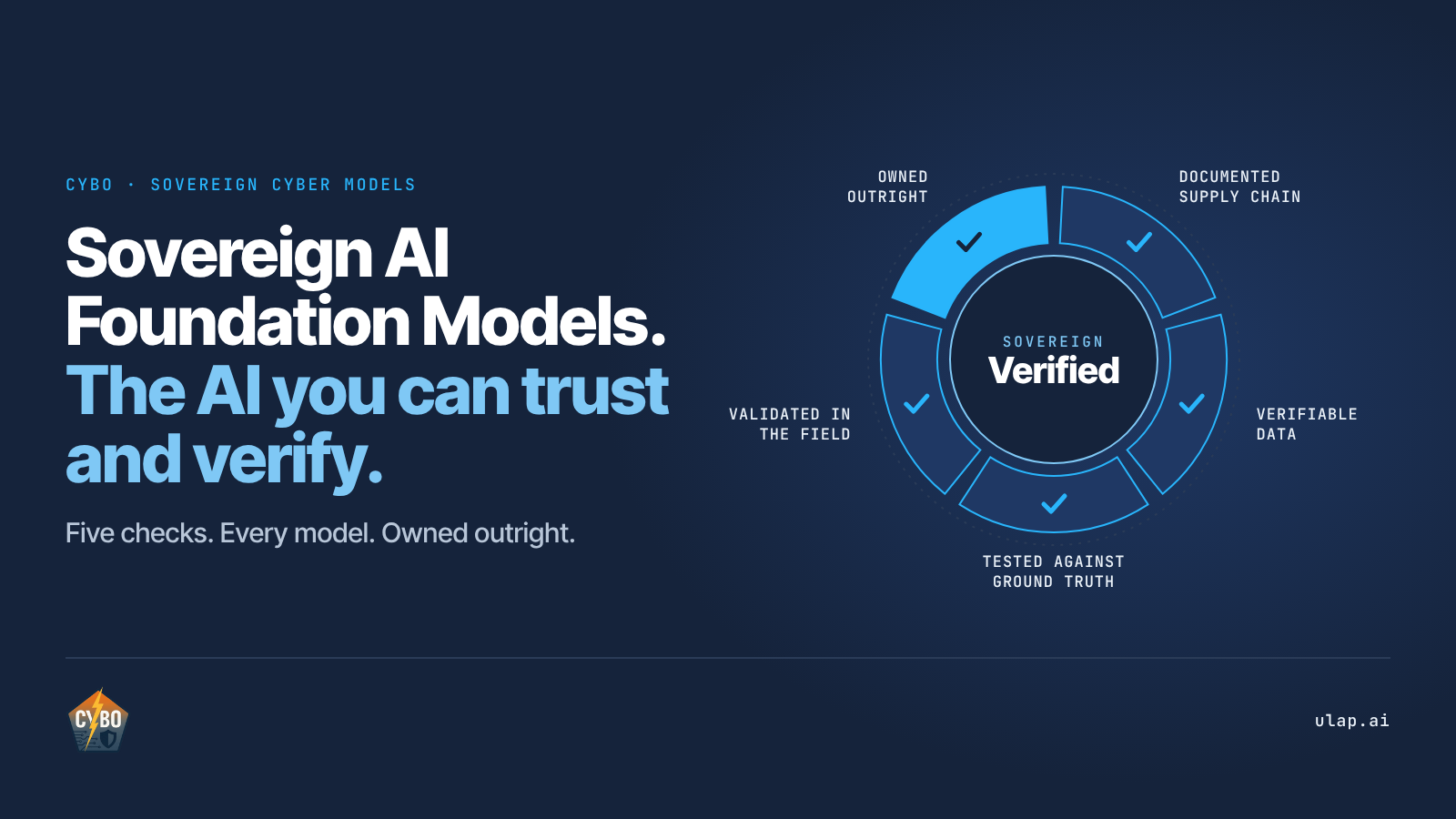
A Sovereign AI Foundation Model meets five criteria.
- Documented supply chain. You know where the model came from, who built it, and what went into it.
- Tuned on verifiable data. The data used to adapt the model can be inspected and traced.
- Tested against ground truth. Performance is measured against known answers for the mission, not generic benchmarks.
- Validated in the operational environment. The model is proven where it will actually run, whether that is commercial cloud, an IL5 enclave, or disconnected hardware at the edge.
- Verified and permanently owned. The organization that depends on the model owns it outright. No one can take it away.
None of these criteria is exotic. Each is a question an assessor, a CISO, or a commander already asks about any other piece of mission software. AI should have to answer them too.
What it looks like in practice
The CYBO models are our reference implementation of this standard. Sovereign cyber models, owned outright.
They run on CERA, Ulap's AI inference engine and gateway. CERA deploys, serves, and governs models inside the customer's own environment, from commercial cloud to IL5 to disconnected edge hardware, behind one API. It brings models in, adapts them to the mission, certifies them, and serves them with policy enforced at the gateway.
That is what makes ownership real. Every application talks to CERA, not to a specific model, so mission owners can select and swap models without rebuilding their tools. The application never changes. Only the placement does.
The products sit on top:
- CYBO Defend scores every answer for accuracy, bias, and summary quality, and shows the query, data, and sources behind it. The machine shows its work.
- CYBO Attest verifies the code going into production, whether a developer, an AI agent, or an open source project wrote it, and a named person approves every authorization.
- CYBO Attack maps the network and automates the preparation phase of offensive operations.
This is in production today
CERA runs in production at IL5 for more than 300 operators. ARCYBER reported an authorization timeline cut from 7 months to about 2 hours (March 2026). The work behind it traces through SBIR Phase I, II, and III efforts with the Air Force, Army, OSD, DTO, Cyber Command, and ARCYBER.
Own the model
The question for any organization putting AI into a mission is simple. When the model changes, who decides?
If the answer is someone else, you do not own your AI. You are renting it. We built Ulap so the answer is you.
Learn more about CERA at ulap.ai and the CYBO family at ulapcybo.app.