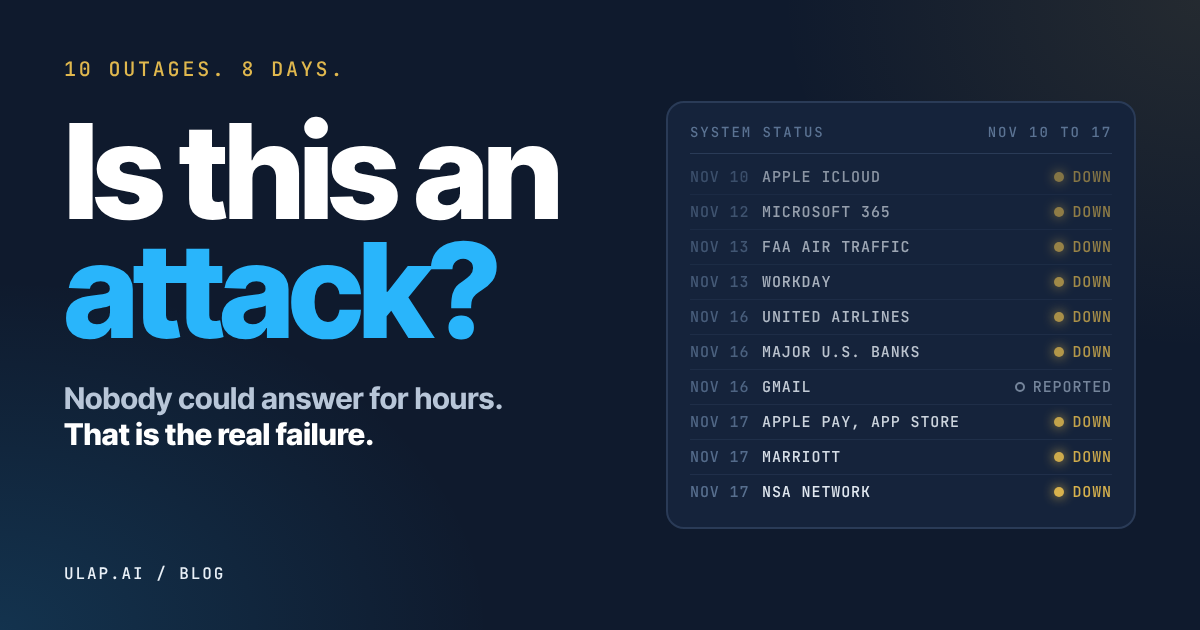
In the last eight days, most of the systems people depend on to work, travel, get paid, and bank went down at least once. Email for much of the world. Every departing flight in the United States. The HR and payroll platform behind thousands of employers, in the middle of open enrollment. The online accounts of the largest banks in the country. And this morning, the internal network the National Security Agency uses for its own communications.
Every time, the first question was the same: is this an attack? Every time, the answer came hours later, and it was the same: no evidence of one. The country's top homeland security official put the whole week down to aging computer systems in need of upgrades.
That is the reassuring answer. It is also the uncomfortable one, and it is worth looking at closely.
What happened
| Date | Service | What happened | Cause given |
|---|---|---|---|
| Nov 10 | Apple iCloud | Mail, Calendar, Contacts, Photos, account sign in, and Find My went down for several hours in the evening. Apple restored service the same night. | Not disclosed |
| Nov 12 to 14 | Microsoft 365 | Outlook, Teams, Copilot, and OneDrive were disrupted in more than 70 countries for well over a day, hitting hospitals, universities, and rail operators. | A problem introduced during an earlier network capacity upgrade, exposed by a later network change |
| Nov 13 | FAA | A communications failure across multiple air route traffic control centers led to a nationwide ground stop, only the second since September 11, 2001. About 3,500 aircraft in the air landed safely. More than 17,000 flights were canceled from Friday through Monday. | Not confirmed; review ongoing with FBI support |
| Nov 13 to 14 | Workday | Employees at about 11,500 organizations were locked out of HR, time keeping, and benefits enrollment. | A disaster recovery test unexpectedly connected to production databases, per a status message shared widely online |
| Nov 16 | United Airlines | A widespread system outage delayed departures for about an hour and a half. | Not disclosed; United said there was no indication it was cybersecurity related |
| Nov 16 | Major banks | A technical issue at JPMorgan Chase rippled into Bank of America, Wells Fargo, U.S. Bank, Capital One, Truist, and Zelle. | A technical bug at Chase |
| Nov 16 to 17 | Gmail | Users reported trouble sending and receiving email. | Google has not confirmed an outage |
| Nov 17 | Apple, again | iCloud, Apple Pay, and the App Store, one week after the first one. | Not disclosed |
| Nov 17 | Marriott | Customers were unable to log in to the app and website. | Not disclosed |
| Nov 17 | NSA | The agency's internal network went down, and staff were given staggered arrival times while the scope was assessed. | A temporary degradation during scheduled routine maintenance, according to one official |
The pattern
Look at the causes that have actually been given. A network capacity upgrade. A later network change. A recovery test that reached production. Routine maintenance. A software update. Where we know anything, the trigger was a change that someone made on purpose, to a system that was supposed to keep running while they made it.
None of these organizations is careless. They run some of the most heavily engineered systems in the world. That is the point. If a planned change can take down Microsoft 365 for a day and a half, the question for every other organization is not whether its own changes are safe. It is whether it could prove they were.
The question nobody could answer fast
The more important failure this week was not any single outage. It was how long it took, every time, to answer the first question.
"No indication as of yet." "No evidence of a cyberattack." "No reason to believe that as of right now this was a threat." Those are honest statements, and the officials who made them were right to be careful. But they are not answers. They are the absence of one. For the first hours of each outage, nobody could show, with evidence, whether the cause was a change or an adversary.
Others filled the silence. By the end of the week, accounts with hundreds of thousands of views were warning of a coordinated nationwide blackout. Nobody could show they were right. Nobody could show they were wrong either.
That gap matters more every month. AI generated attacks and AI written code now outpace human processes and tools. An adversary who knows that a week of outages will be read as bad luck has every reason to make the next one look like bad luck too. When ten things break in eight days, the cost of not knowing quickly is not just embarrassment. It is either a real intrusion hiding in the noise, or responders spending their first hours chasing one that was never there.
What this week should change
Verify every change before it runs, and keep the record. Most of what broke this week broke because of something that shipped: an upgrade, a configuration change, a test pointed at the wrong place. Checking a change is not enough on its own. The check has to leave a record: what changed, what was verified, what was accepted and why, and who reviewed it. When something goes wrong a week later, that record is the difference between an answer you can open in minutes and an investigation you have to start from scratch.
Answer "is this an attack?" with evidence, not reassurance. The first hours of an incident are when the answer matters most and when most organizations have the least to show. That means knowing your normal well enough to see what is different, checking what you see against current threat intelligence, and being able to show the reasoning behind your conclusion: the data, the sources, and how you got from one to the other. A confident answer with no explanation is not a trustworthy answer. That holds for a security tool, and it holds for a press briefing.
Do not let one provider's bad day become yours. When Microsoft 365 went down, Copilot went with it. As more work runs on AI, a single model or a single cloud becomes a single point of failure, and most teams have built their tools in a way that makes switching slow and painful. Know which of your critical systems depend on one provider, and know what you would run on if that provider went dark for a day and a half.
Aging systems are the slow fix
Replacing aging infrastructure is necessary, and it will take years and tens of billions of dollars. Washington is already asking for that money for air traffic control alone. It should.
The faster fix does not wait for new hardware. Every change verified before it runs. Every alert explained with its evidence. Every decision traceable to the person who made it. None of that would have prevented every outage this week. All of it would have shortened the hours when nobody could say what was happening.
When your next outage hits, how long will it take you to prove it was not an attack?
Update, November 17
Since this post went up, two things have changed, and both make its point stronger.
The week did include one real attack, and it was not an outage. On November 16, malicious code was served to visitors of 178 organizations' websites, including Zoom, the BBC, CNN, and HSBC, through a flaw in Optimizely, a website testing service those sites load. Optimizely says it removed the code and fixed the flaw. The researcher who found it stresses that these are potentially affected sites, not confirmed breaches, and says he saw no evidence of AI involvement.
The FAA's explanation is also less settled than it first looked. The router maker says its device worked as intended, investigators are asking why a second router more than 500 miles away also flooded the network, and the FAA has paused installing those routers. A week later, the question in this post's title still does not have a final answer.
This is the problem we work on at Ulap. CYBO applies Explainable and Trustworthy AI to cyber. CYBO Defend automates cyber defense: it checks what is happening on the network against current threat intelligence, acts on what it finds, and shows the data and sources behind every answer, so "is this an attack?" comes back with its evidence. Learn more at ulapcybo.app/defend.html.
Sources: Apple System Status and 9to5Mac, iClarified, and iTechify reporting (November 10 and 17, 2026). Microsoft 365 Status; Digital Trends, BleepingComputer, Windows Forum, and SecurityWeek reporting (November 12 to 14, 2026). FAA, "Nationwide Ground Stop: Questions and Answers" (November 15, 2026); Christian Science Monitor, Gray News, and Yahoo News reporting (November 13 to 16, 2026). Fox Business, LiveNOW from FOX, and Emerson College notices on Workday (November 13 to 14, 2026). Associated Press, NBC News, and The Washington Post on United Airlines (November 16, 2026). Associated Press and ABC7 on bank outages (November 16 to 17, 2026). Fox News live coverage on Gmail and Marriott (November 17, 2026). CNN, CBS News, and The Wall Street Journal as reported by The Jerusalem Post on the NSA network (November 17, 2026). Report URI on the Optimizely injection (November 17, 2026), with Newsweek and CoinDesk reporting (November 17, 2026). Fortune, ABC News, AeroTime, and The Wall Street Journal as reported by Yahoo News on the FAA investigation (November 15 to 17, 2026).