On November 16, Google's Threat Intelligence Group and Mandiant published their quarterly AI Threat Tracker, "Agentic Threat Activity Crosses a Significant Threshold." In a statement with the report, Google put it plainly: "The era of autonomous attacks has arrived." Three days earlier, the FBI had warned that criminals are using an AI framework to automate intrusions from start to finish. And on Monday, cybersecurity expert David Kennedy made the same point on Fox News in a clip that spread across X: AI is turning average hackers into elite ones.
The warnings landed in the middle of a week of outages, and many people connected the two. So far the record does not. Officials traced the FAA ground stop to a router that flooded its network during a contractor's upgrade; the root cause is still under investigation, and the FAA administrator said there was no evidence of anything nefarious or AI related. The other causes on the record are bugs and releases. The one confirmed attack of the week, malicious code planted on 178 organizations' websites through a website testing vendor, showed no sign of AI either. That should not be read as reassurance. It means the warnings describe what is coming, not what already happened, and there is still time to get ready for it.
What the FBI found
On November 13, the FBI published a FLASH alert on ARTEX, an open source penetration testing framework built for authorized security testing. ARTEX has no model of its own. It plugs into outside large language models, splits an objective into tasks, and hands those tasks to agents that run the tools and share what they find. Once it starts, it needs little human input.
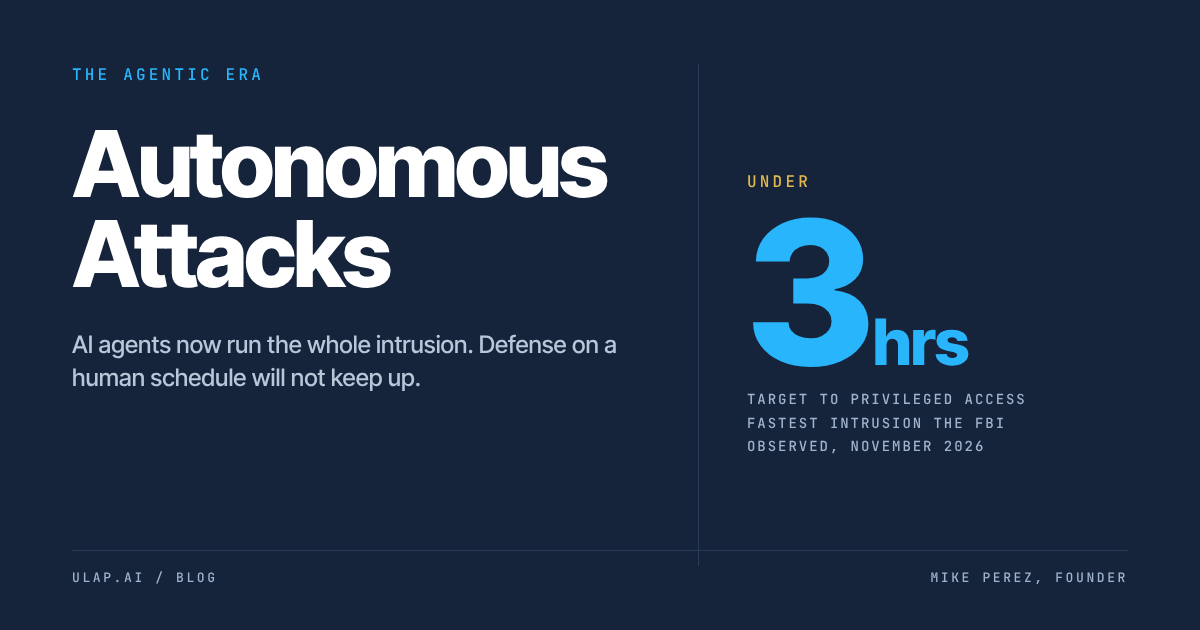
The FBI says malicious actors have used it since at least August against finance, government, healthcare, technology, and other sectors. In some intrusions, attackers went from choosing a target to holding privileged access in under three hours. The framework chains small weaknesses, an old portal nobody remembers or an exposed cloud credential, into a full intrusion.
What Google found
Google's report describes what it calls the first observed case of attackers using an AI framework to find a vulnerability and build a working exploit with no human involved. Google added that defending against machine speed threats at human speed is not feasible. Its projection: within three months, simple attacks run by multiple AI agents with little or no human interaction, and within six months, sophisticated attacks that run fully on their own.
The skill moved into the tool
That is what turning average hackers into elite ones looks like in practice. One security executive put it plainly after the FBI alert: when an AI framework chains reconnaissance, exploitation, and privilege escalation in a few hours, the attacker no longer has to be skilled. The skill used to live in the person. Now it lives in the tool, and anyone can point the tool.
That changes the math for defenders in two ways. There will be more attackers, because the barrier to entry is gone. And each attack will move faster than the processes most security teams run today: an alert in a queue, a ticket, an analyst who picks it up after the meeting, a handoff at the end of a shift. Three hours is less than one shift.
What changes for defenders
- Detection has to keep pace with the attacker's tools. An analyst triaging alerts by hand will not see an intrusion chain that finishes before the next shift starts. Defense needs automation of its own, watching network activity continuously and checking it against current threat intelligence as it happens.
- Automated defense has to show its work. Speed without explanation creates its own outages. A tool that blocks, isolates, or escalates on its own has to show the data and the reasoning behind each decision, so a person can trust it, correct it, and answer for it. A confident answer with no explanation is not a trustworthy answer.
- Telling a change from an adversary has to be fast. Most damage still starts at home, with a bad release or an upgrade gone wrong. When something breaks, the first question is whether it was a change or an intruder. A team that can answer that from evidence, quickly, is ready for both.
The attackers are getting help
AI generated attacks and AI written code now outpace human processes and tools. The FBI and Google have now documented how attackers are getting help from AI. The question for every security team is whether its defenders are getting the same help, at the same speed, and whether they can see why that help does what it does.
This is the problem we work on at Ulap. CYBO applies Explainable and Trustworthy AI to cyber. CYBO Defend automates cyber defense: it checks what is happening on the network against current threat intelligence, acts on what it finds, and shows the data and sources behind every answer, so every decision can be traced and someone can answer for it. Learn more at ulapcybo.app/defend.html.
Sources: Google Threat Intelligence Group and Mandiant, "GTIG AI Threat Tracker: Agentic Threat Activity Crosses a Significant Threshold," Google Cloud blog (November 16, 2026), with Google's statement as reported by The Hill and Newsweek (November 17, 2026). FBI FLASH alert, "Threat Overview of ARTEX Autonomous Penetration Testing Framework" (November 13, 2026), as reported by Malwarebytes, Infosecurity Magazine, and SC Media. Fox News segment with David Kennedy, as shared on X (November 17, 2026). NPR and Reuters on the FAA ground stop and the Transportation Secretary's briefing (November 14, 2026). Report URI and Newsweek on the Optimizely injection (November 17, 2026).